
Are You Ready for Children?

In an excellent and provocative post entitled, "Wondering if you should have children or not?" Emily Willingham attempts to help prospective parents — primarily prospective mothers — answer that question by asking them a question in return.
I'll summarize what I think is the thrust of her post: While the chances are your child will be fine, a not insignificant number of parents will have a child with a lifelong disability, and there is no way you can control that. If you're not ready to commit every last bit of energy and time to that endeavor on the off-chance that this will be your future, don't have children.

In her words: "Parents are an accident or a developmental milestone or a virus away from having their lives change in ways no one can predict." She continues, "It's not a question of 'If I become a parent, will I still be able to work?' It's a question of, 'If I become a parent, am I prepared to be nothing but a parent all day, every day, if a sudden change, infinitely unpredictable, requires it?'"

Blunt, uncompromising, perhaps unpleasant, but true.

I don't know how I would have answered her question before becoming a parent. I think I knew it would be hard, largely because of my own experiences growing up (e.g., losing two brothers, etc.). All I know is that now that I'm in this life — like most parents in the same situation — I'm doing my level best.

That said, the fact is that the majority of this burden falls to my wife. I try to be the best, most engaged father I can. And still…her shoulders carry more of this weight.

Raw Nerves and Bad Reactions

If you tell me my son is a curse or revenge from God, I'm not likely to react well.

Tonight I wrote a nasty note to a politician who, a few years ago, made such a statement. He later apologized, saying he'd chosen his words poorly. He did, however, go on to say that medical studies support the contention that mothers who have sinned, in particular by having had an abortion, are more likely to have a child with disabilities. Ironically, this politician is, in other regards, an advocate for the disabled on both a professional and a personal level.

But I digress.

I'm not proud of the note I sent tonight. It was crude and angry and, upon reflection, belied my own lack of sound judgment. Yelling at people online rarely does any good at all, even when you're right, and I know this.

Except, this is my son, and he's not a curse from God or Nature or whatever. And if you say things like that, no matter how you qualify it, you had better expect that some people, especially those actually raising children with disabilities, may not take it well.

I feel bad about having written the note, and in particular for letting his words get the best of me. I'm raw and I'm tired and I need a break. But that's no excuse. It's just what it is.

30 30 30

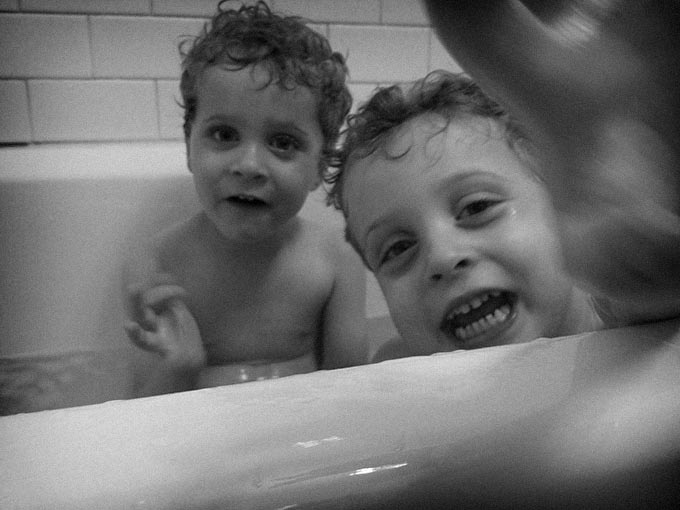
Bath time During bathtime, I brush C's teeth while counting to 30; he knows that when I reach 30, we're done. (Ah, the tricks we learn.)
Last night when I reached 30, C perked up and said cheerily, "30, 30, 30!"

I smiled. "Yes, 30!"

He then said, "40, 40, 40, 40!"

Me: "40?"

C: "50, 50, 50, 50, 50...60, 60, 60, 60, 60, 60!"

It took me a minute before I figured out what he was doing. Finally I said, "What about 70?"

C: "70, 70, 70, 70, 70, 70, 70! Seven 70s! Then eight 80s!"

No one has taught him this. It's just one of his many little surprises for us.

Indefinitely

Indefinitely Today we received the results of a psychological exam C underwent a few weeks ago, and the first line made me smile: "C is a very handsome, 3-year-5-month old male…" Those words echoed words written in one of his first evaluations: "C is a darling little boy…"

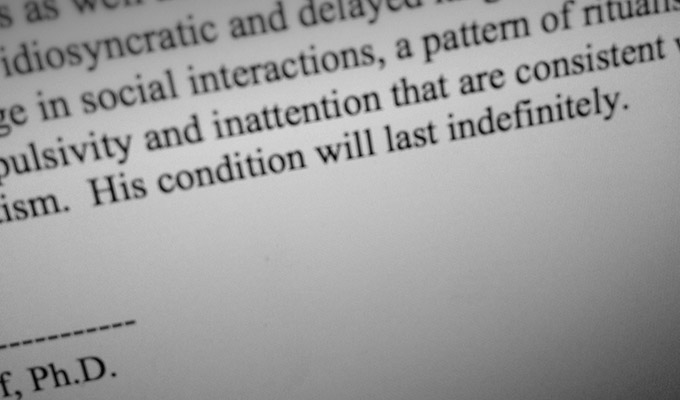
Like the earlier evaluation, this latest one was thorough and contained few if any surprises. However, the very last sentence had the opposite effect of the opening line. It read, "His condition will last indefinitely."

I was sitting at my desk, the words ringing in my ears as if they had been yelled in an echo chamber. I felt the wind go out of me, and that surprised me: I've come to accept the fact that C will always have autism, that this condition isn't going away. I've even come to accept that wishing autism would go away is like wishing C would go away, and I don't ever want that to happen.

I have high hopes for C. I'm very optimistic that with work and love and patience, he will make great strides. I'm not delusional, I understand the reality of his situation, but I've come to love many of the quirks that make C my darling little boy.

And yet a few succinct if accurate words from a trained professional can make me feel like I'm falling apart at the seams...but only for a moment.