
We finally got around to watching Loving Lampposts tonight, a beautiful, touching, and enlightening documentary by a fellow Brooklyn Dad. It tackles tough issues, but in a positive way. A definite recommend. Learn more about Loving Lampposts
Summer's Last Days
 We're spending this long Labor Day weekend as we do most weekends: going to playgrounds and parks, running errands together, and visiting friends.
In just a few days the twins will begin attending different schools; it's hard to imagine the boys apart, since they've been together since birth. Nonetheless, we know this is what's best, and we even wonder if the time apart might bring them closer still.
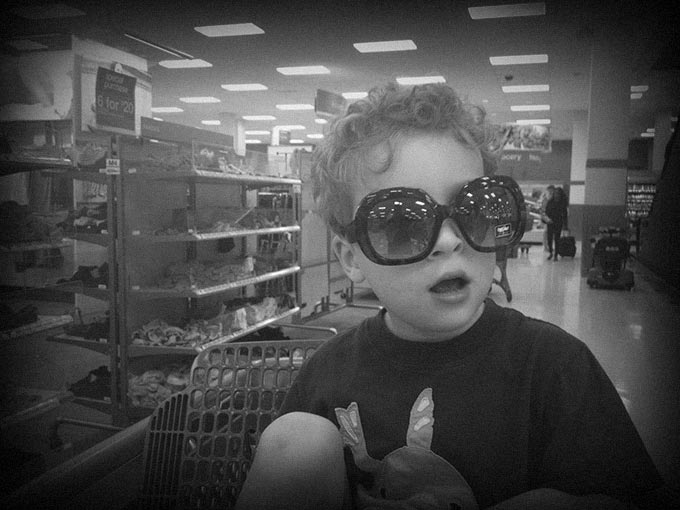
Above: C hams it up in ladies' glasses at Target
In other news, C did two things today that blew me away. Tonight in the bath, as M protested my brushing his teeth, C said, "M doesn't want you to brush his teeth!" It was the first time I'd ever heard him reflect on the feelings or wants of his twin so directly, and it took me by surprise.
The other event involved identical train conductor hats we bought for the boys at Target yesterday. This morning C suddenly bolted upstairs saying he needed to get one of the hats; we had no idea why, since he was already wearing one. When he found it, he ran back downstairs and handed to to M, saying, "You wear it, M!" Again, I've never seen this kind of reciprocity from C toward his brother, so I was thrilled.
The day ended on a slightly less stellar note: C's evening stims have gotten pretty severe. He is completely unable to settle himself, and spins around and around in his bed, thrashing and screaming at the top of his lungs (what must our neighbors think?). His screaming and thrashing is actually starting to frighten M, so we have taken to letting M fall asleep in our bed until C settles down.
We're doing research on ways we can minimize the evening stims, but we know this is a phase and we're just going through a rough patch. Of course with autism, every bump in the road makes you wonder if things are just going to get worse from here, but time has shown us that, overall, C is making progress. We just have to continue working on the problem areas and supporting the good stuff.
A Watchful Eye
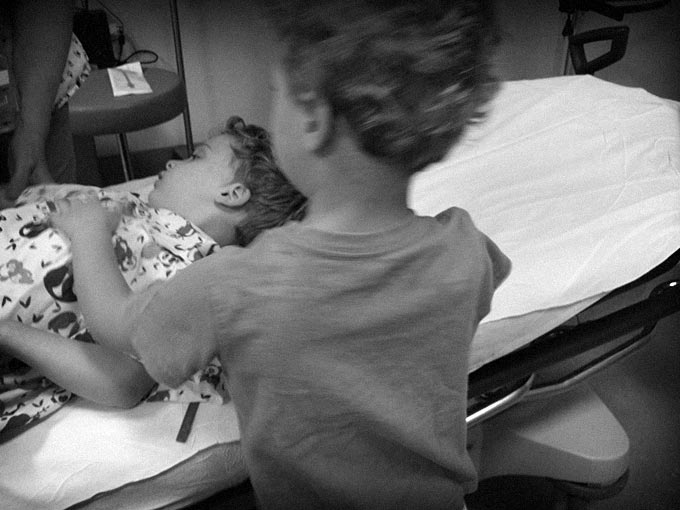
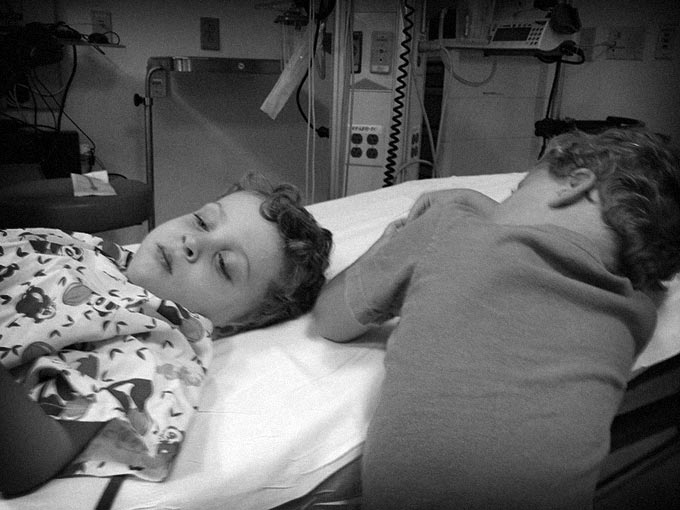
C has bad reactions to anesthesia, so the day after his most recent pulmonary function test we ended up in the ER. Everything turned out fine, and we got to witness a special moment when M kept a watchful eye over his twin.
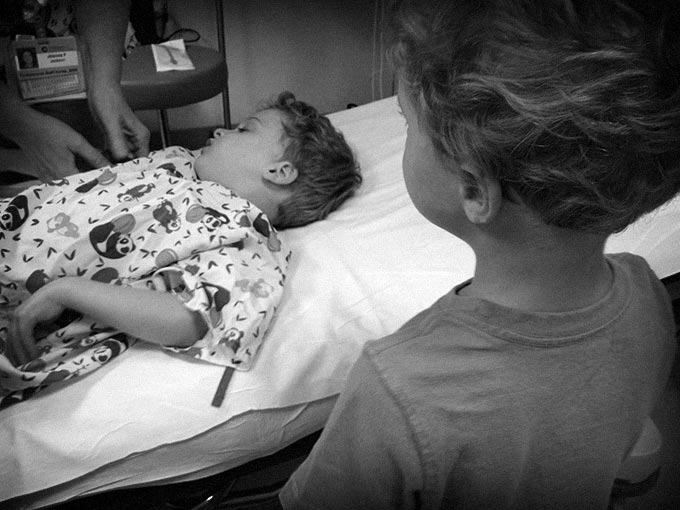
Everyone assures me that, despite outward appearances, our boys have a deep connection. I'm beginning to see the truth in their conviction.
Debunking the Theory du Jour
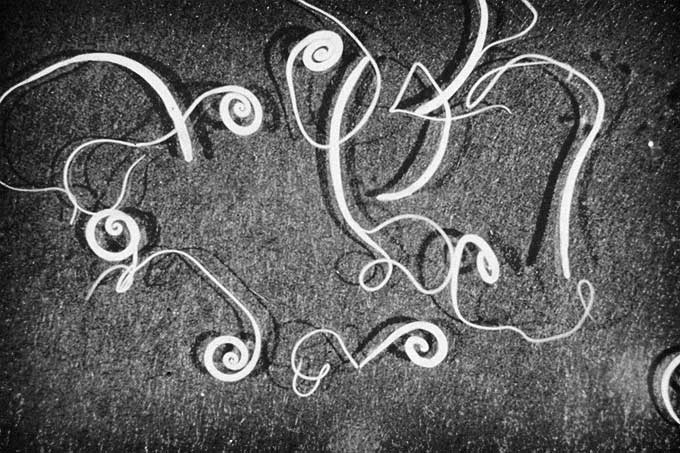 Above: a cure for autism?
You may have heard or read last Saturday's NY Times article by Moises Velasquez-Manoff correlating autism with immunity and influenza, and going further to suggest an, ahem, unorthodox means of preventing autism (spoiler: parasitic worms!).
I'll admit, on first read the article seemed credible. Upon subsequent readings, however, I got an uneasy feeling. Something about it didn't seem…right.
I'm not a scientist, obviously, so I couldn't put my finger on what, specifically, was bothering me. I did note that the author made several giant leaps of logic, and made some causal connections that seemed tenuous at best. Then there were some statements that just seemed…off (e.g., if medical care in third-world countries is so poor that they live with widespread parasitic infections, how can we trust their stated rates of autism? And mice may show signs of autistic behavior, but neurologically they do not have autism.).
Since I'd noted a bit of a splash (if that's the right word) around the Web after the article was published, I thought I'd try to write about my qualms. Then I came across a post by biologist, writer, and editor Emily Willingham that did a far better job expressing my concerns than I ever could. Her rebuttal to the article is excellent; if you have time, read it here.
At the end of her detailed and thoughtful post is this closing statement, which pretty much sums it up:
"What we have here is an argument that relies on shaky and shifting hypotheses of autism and autoimmune epidemics and hygiene, built using sparse data and scientific hints, a poor understanding of basic evolution and ecology, and a paradox of calling for a return to a more infectious past to 'cure' autism while blaming immune-dysregulated, occasionally infected mothers of the present for...autism. In his closing, Velasquez-Manoff argues that evolution provided us with a roadmap of the original microbial and parasitic ecosystems we once were, one that, presumably, if we follow it, will guide us out of the 'insanity' and 'affliction' that is autism. If it's possible, that's where he's most wrong. Evolution isn't something that happens with a plan. To describe it in those terms is to have a profound failure of understanding of what evolution is. Where we're going, evolutionarily speaking, there are no roads. And it would be better for most of us if there weren't any parasitic worms, either."
Let me state it here and now: I'm unequivocally pro-science. Real science. Science that is rigorous, replicable, peer-reviewed, and proven. Anything less is speculation, and while there's nothing inherently wrong with speculation (it's where science often begins, after all), speculation should never be passed off as fact.
Velasquez-Manoff's piece was published in the Op-Ed section but positioned itself as a matter fact. It's not. There's simply too much speculation, circular thinking, reliance on tenuous causality, and hyperbole. Is it an interesting theory, one worthy of further research? Perhaps. But is it science? Not yet anyway.
Breathing Easy
Big news: C no longer needs supplemental oxygen!

Above: an oxygen-free C.
When C first got sick almost three years ago, we had no idea what was wrong. Neither did his pediatrician. After a few months of declining health without answers, we carried our pale, faltering little boy in our arms to the local ER where they discovered his oxygen levels were dangerously low - in the 70s (below 90% is considered dangerous). On top of that, his CO2 levels were dangerously high. Not good.
He was put on supplemental oxygen immediately and has been on it continuously until just a few weeks ago. (Aside: we will always wonder if this period without oxygen was partially responsible for triggering his autism.)

Above: C the night of his emergency admit (the first one, I should say).
It took almost six months to get an official diagnosis. Before that, we got varying theories about what might be causing his respiratory problems ranging from cystic fibrosis to something called bronchiolitis obliterans. At one point, we were told C might have a disease that would require a lung transplant, and which could result in death. Shit.

Above: C feeling better after just one evening on supplemental oxygen.
Thus it was with a giant cry (literally) of relief when the results of a lung biopsy revealed that C had a very rare but relatively benign pediatric lung disease known as neuroendocrine hyperplasia of infancy, or NEHI for short. Less than a few hundred children worldwide are diagnosed with this disease. Little is known about its cause, there is no cure, and the only treatment is supplemental oxygen. It's no cakewalk, but it was better than many of the other potential diseases we were facing: NEHI is not deadly, doesn't require a lung transplant and, as far as the research goes, all children afflicted with it will ultimately outgrow the need for supplemental O2.
We thanked our lucky stars and settled in for the long haul: life with a child on oxygen.
Smokers take note: life on oxygen is a major hassle, not to mention a financial burden. With a child, it's even worse: oxygen tubes knock everything over; explosive oxygen tanks get stored in closets; noisy oxygen equipment constantly gasps around the house; people stare; insurance companies balk at expenses and you do battle for your child; and of course there is the ever-present fear that the next cold will result in another hospital stay.
Still, we're lucky. C is off oxygen, and just before preschool! (To those schools who discriminated against our son because of his medical condition: screw you. We might have sued you if we had the energy, money, and the time. Instead, you bullied us and lied to us. I apologize for the outburst but I had to get that off my chest.)
We will keep the oxygen equipment around for awhile, just in case C has a relapse. There is no study which has confirmed whether NEHI ever truly disappears, or if the lungs simply grow large enough to compensate for the diseased areas. What we do know is that his saturation levels are healthy, and the latest pulmonary function test revealed vastly improved lung elasticity and reduced air trapping. His lungs aren't perfect, but they're much better than just a year ago.

Above: C at a water park around the time of his first confirmed autism diagnosis.
We are thrilled and relieved. Life will be easier in many ways. But I would be lying if I told you this news brought us profound happiness. This outcome means we can simply refocus all our energies on the more pressing issue of autism. I don't mean to say we're not grateful and happy: we are. Most of all, we're grateful that C will enjoy life without the limitation being dependent on supplemental oxygen.
People have asked what C's reaction is to being off oxygen. Does he notice it? Is he happier? I wish I could say he was thrilled to be off it, but the truth is that he hasn't shown any real difference in demeanor. His usual obliviousness is, in this case, a blessing: he never really seemed to mind being on oxygen in the first place.
That said, the other night I asked him if he missed his (ever-present) nasal cannula. His response? He smiled and stuck his fingers into his nostrils.
That's my boy!
///
If you would like to support a fantastic organization that does a lot to help parents of children with pediatric lung disease, please visit chILD Foundation and consider making a donation.
Quisque iaculis facilisis lacinia. Mauris euismod pellentesque tellus sit amet mollis.