
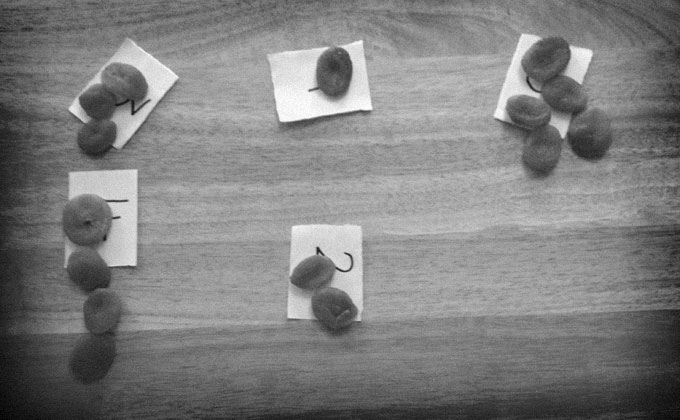
 A little fun combining C's love of organizing, counting, and apricots.
His Own Way
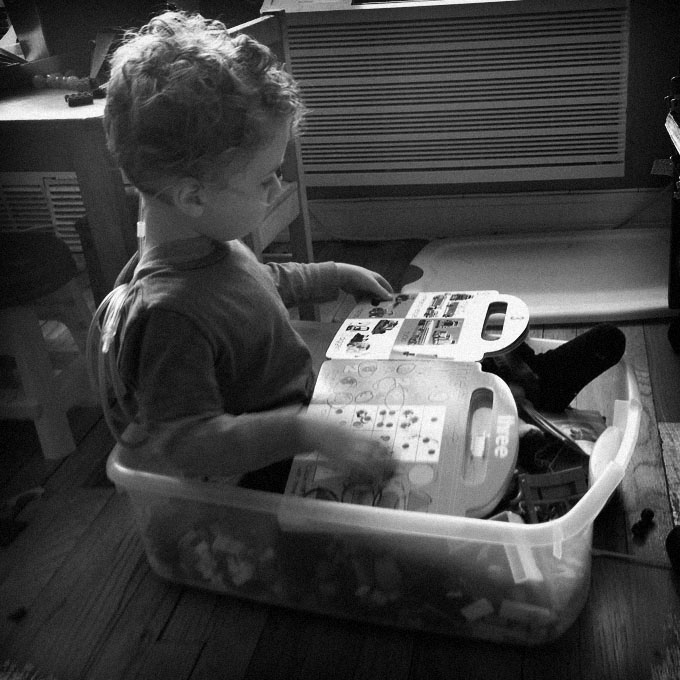 At a friend's apartment, all the kids were running and playing except for C who, in his typically unique way, found a toy box to sit atop. Why not?
The Future That Wasn't
In this lovely NY Times blog post, Joel Yanofsky writes of his family's preparations for their autistic son's impending bar mitzvah. The whole post is humorously touching, but I wanted to cite one line that really hit home:
When you have a child with autism you soon learn that you have to teach him everything, especially things most kids pick up intuitively — from playing with toys to carrying on a simple conversation.
This is it in a nutshell, the thing I keep trying to get at when I describe C's autism. You see, on their own the symptoms sound like a collection of personality quirks: repetitive behaviors, echolalia, lack of social reciprocity, lack of imaginative play, physical tics, etc.
The combined effect of these 'quirks,' however, is that C fundamentally does not understand how to interact with the world. Whereas his neurotypical twin is figuring things out on his own every hour of every day regardless of what we teach him, C needs to learn how to learn, if that makes sense. It's so much more fundamental.
And that is why, when Yanofsky writes this line, he really nails it:
The future is a scary place for every parent, but it’s especially so for the parent of a child with autism. No one has ever been able to tell Cynthia or me with any degree of certainty what our son is capable of.
We were cautioned by a doctor just after my son's diagnosis that we should never look too far into the future. "I've seen children we thought would do quite well who failed to progress," she said, "and I've seen children who were essentially written off who ended up surprising us all."
Sometimes I feel robbed of an imagined future, but I feel fortunate to have such a wonderful present.
Sight Reading
Yesterday we witnessed something amazing: C is able to sight-read some words, and then match them to images. (This is the first time C has done this exercise with his ABA therapist; ironically, the point of the exercise was to help him with fine motor skill such as holding paper, not reading.) These are words C likes to spell, so he's already familiar with them. Nonetheless, he's seeing the words out of context and attaching meaning to them. In other words, pre-reading.
I know that when I tell people about this, some of them will think, "Well, there's more proof he's smart and maybe just a little unusual." It can be frustrating having to constantly explain that, yes, my son has some abilities that are beyond his 3.25 years of age, but in other areas he has severe deficits. People tend to assume average to better-than-average cognitive abilities mean there are no serious problems.
Nonetheless, I am thrilled with this development: it is heartening to know that despite the deficits, he has a great brain hard at work.
A Different Story
 When I came home tonight, C was standing quietly by the window arranging his cars just so. This is nothing new: he often moves objects around, reconfiguring them until they match some picture in his mind.
When I ask C about his cars, there is no imaginative story of a freeway or traffic jam or people on their way to work. There is only the patient process of arrangement.

Of course, I can't help but look at the cars and see the pattern he's created: from left to right, police car / 3 cars / police car / 3 cars / two buses. If he didn't create patterns all the time, I might consider it a coincidence, but I know now that it's like his own morse code, a message to himself or the rest of the universe.
While I still wish C could tell me a story about his cars, I am coming to accept that the cars are telling me a story about my son.
Quisque iaculis facilisis lacinia. Mauris euismod pellentesque tellus sit amet mollis.