
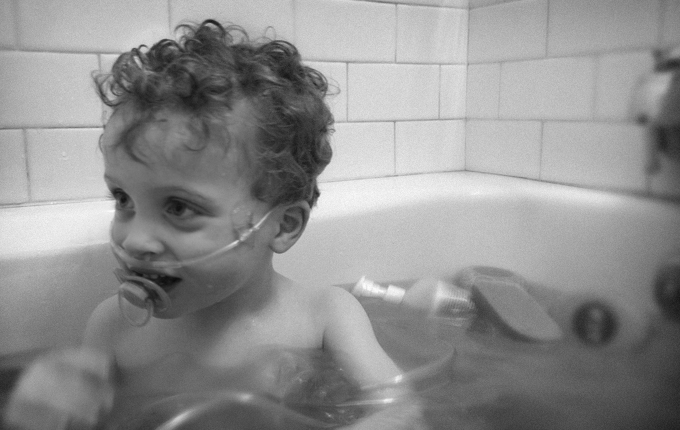
 I feel so fortunate that C is a happy boy.
Helping Hands
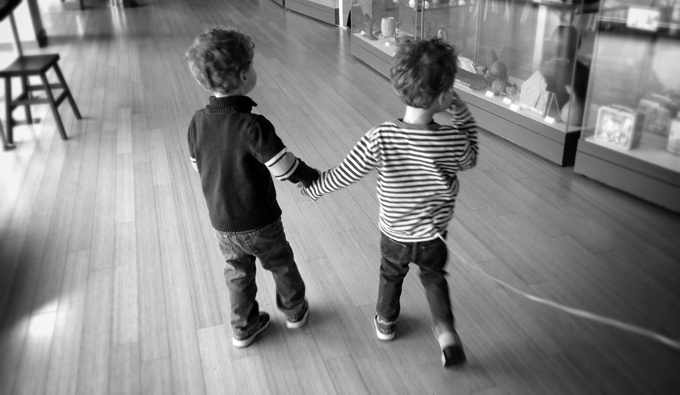 The dream of every parent of twins is that their children will be best friends, lifelong companions. We saw that dream evaporate when C began to regress.
Lately, though, we've been encouraging M to take charge, to be C's protector and role model. He's only three, but I think M is enjoying the role, and C is certainly enjoying the attention.
My heart swells.
It's Not a Phase
Google "autism denial" and you'll see there are a lot of parents of ASD kids being told by well-meaning if ill-informed friends and family that their children are just "going through a phase." To those people I'd just like to say, autism is not a phase. Sure, it's possible with help and time the ASD child may improve. Or they may get worse. I guess in that sense autism has its phases.
But autism is a lifelong condition, not a fleeting trait. It is how the brain is wired, and it informs the very nature of the autistic individual.
It's not just being shy or awkward or unique. Autism doesn't just refer to children incapable of communication. And it doesn't mean the ASD child can't be bright or happy or even funny, nor does it mean they will be a Rainman-like savant.
In fact, it is often said there are as many forms of autism as there are people with autism. I suppose this is true, but across the spectrum there are common, detectable traits that define the condition, regardless of any individual's unique personality.
I think it's worth noting that friends and family who suggest "it's not autism" mostly do so from a place of love; they have good intentions. They don't want to believe it to be true. What they may not realize is that by denying the diagnosis, they are undermining the very people they love.
Imagine if you had cancer, but everyone you loved told you it was probably something else...indigestion or stress or poor sleep habits. How would that make you feel? It would be downright maddening.
No one wants to accept the autism diagnosis, least of all the parents whose child has been so diagnosed. But once that truth has been accepted by the parents, friends and family would do best to get on board, or keep their opinions to themselves.
A Robot That Teaches Emotions
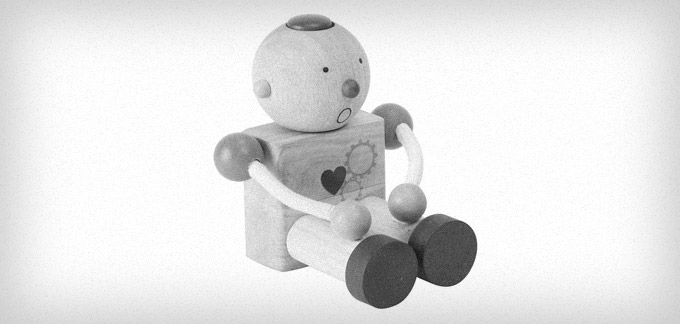 I know what I'm getting C for his 3rd birthday in a couple of weeks: a new robot from Plan Toys designed specifically to help ASD children identify emotions, address sensory issues, and improve fine motor skills. As a bonus, the robot is made in an eco-friendly fashion.
I just read about it on Co.Design, and I've already ordered one from Amazon. C seems to understand "happy," but it's less clear to me that he's able to interpret other emotions like anger, fear, or surprise; this is a common ASD trait.
According to the article, "Laura Chun Urquiaga, a former photojournalist, designed the toy in consultation with a team of experts in ASD, ranging from occupational therapists and parents of children with ASD to researchers and teachers. In response to parent requests for a toy that didn’t look like a special-needs tool, Urquiaga settled on a robot figure that would appeal to both boys and girls, as well as children without ASD."
I hope C enjoys it; I'll report back when he's had a chance to try it out.
Missing Monkey
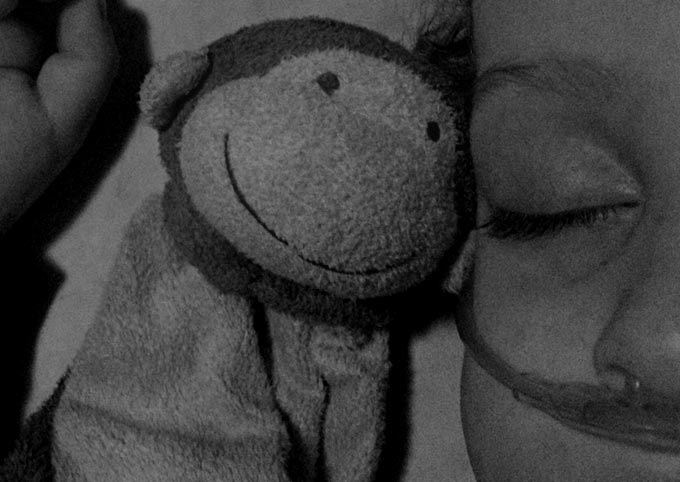 I feel terrible. Tonight when I put C in bed, he wouldn't stop crying. I asked him what was wrong, but he couldn't respond coherently. I knew he was exhausted after a full day of therapy, so I rubbed his back until he drifted off.
It wasn't until an hour later that I realized what was bothering him: I'd left his monkey downstairs. This is the monkey he carries with him everywhere, the monkey that's been with him since the beginning. This is the monkey he treasures so much that we actually have a backup just in case. This is the monkey that, for a while, C referred to as "Munchee."
C, sometimes I wish I could understand you better. I really do.
But it's not his fault. I should have been paying closer attention. I brought monkey upstairs and put him right where he belongs.
Quisque iaculis facilisis lacinia. Mauris euismod pellentesque tellus sit amet mollis.